beds
|

Beds

E-commerce (Furniture & Bedding Retail)

Magento 2 Custom Development for Beds.co.uk

To enhance automation, optimize store management, improve data accuracy, and streamline daily operations while ensuring a smooth shopping experience for end-users.

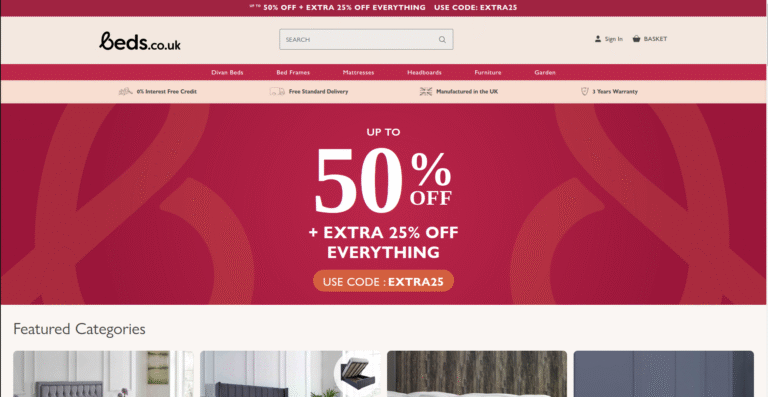
Beds.co.uk is one of the UK’s leading online retailers for beds and mattresses, managing a large inventory and high-volume daily sales. The client required advanced automation and custom functionalities to improve operational efficiency, prevent pricing errors, and better integrate with their ERP and marketing systems.
beds

Grok Development delivered a seamless migration and an impressive set of custom features that transformed our operations. The Magento build—combined with the ERP and payment work—stabilised stock sync, stopped pricing errors, and increased average order value through well-executed upsells. The team was responsive, pragmatic, and delivered on time. Highly recommended.

Beds.co.uk

Jane Smith, Head of E-Commerce

CASE STUDY

What we’ve done

Our team was engaged to design and implement several custom Magento 2 modules and system integrations, focusing on automation, reporting, data validation, and enhanced product management.

Challenge: Beds.co.uk originally ran on a WordPress + WooCommerce stack with customer, product, and order data fragmented across plugins and customizations. The client required a robust migration to Magento 2 to support scale, complex product types (configurables/bundles), and advanced integrations.

Scope & Approach

  1. Discovery & Mapping
    • Inventory of WooCommerce data: products (simple/configurable/grouped), categories, attributes, customer accounts, historical orders, coupons, images, tax rules, shipping methods.
    • Mapped WordPress/WooCommerce data model to Magento 2 equivalents (attributes, attribute sets, configurable product relations, category tree).
    • Identified custom fields, third-party plugin data, and SEO/permalinks to preserve.
  2. Data Preparation & Cleansing
    • Normalized SKUs, product attribute values, and taxonomy.
    • Cleaned duplicates, fixed malformed prices, standardized weights/dimensions.
    • Resolved legacy image paths; consolidated image variants.
  3. Migration Pipeline
    • Built repeatable migration ETL pipeline (CSV + API hybrid): export → transform → validate → import.
    • Automated SKU mapping rules and category mapping scripts.
    • Preserved customer hashed passwords where possible (mapped using safe rehash approach) or forced secure reset workflow when necessary.
    • Preserved order history with payment/order statuses and invoice/shipping records for accounting continuity.
  4. Product Transformations
    • Converted WooCommerce variations into Magento configurable products with correctly linked simple products.
    • Applied auto-SKU formatting rules on creation (CONFIGSKU-VARIANT), ensuring ERP compatibility.
  5. Price & Catalog Validation
    • Enforced price validation at import time (to prevent zero-priced items) using the custom Price Validation module (see below).
    • Ensured tax class mappings and special price windows were maintained.
  6. SEO & URLs
    • Migrated permalinks and canonical tags; created 301 redirects from old URLs to new Magento routes to maintain search rankings.
  7. Testing & QA
    • Full staging environment test runs: data integrity checks, sample order flows, checkout/payment (Payoneer test transactions), and ERP handshake tests.
    • Reconciliation reports comparing orders, SKUs, customer counts, and revenue totals between source and target.
  8. Go-Live & Post-Migration
    • Final incremental sync to capture recent orders during cutover window.
    • Monitoring for 7–14 days with hotfixes for discovered edge cases.
    • Staff training on Magento product management, promotions, and the new admin reports.

Outcome

  • Successful migration with preserved order history and customer accounts.
  • Standardized SKUs and attributes improved ERP sync reliability.
  • Zero critical data loss; SEO traffic dips mitigated via redirects and canonical preservation.
  • Smooth transition enabled full use of custom Magento modules developed in this engagement.

Challenge: The client frequently updated promotional banners but relied on manual deployment, increasing the risk of delays and outdated banners on live pages.

Solution:
We developed an Automated Banner Scheduling module that allows administrators to upload banners with:

  • Custom attributes (title, URL, category relevance, and priority)
  • Start and end dates
  • Device-specific visibility (desktop/mobile)
  • Sorting based on campaign priority

The system automatically enables and disables banners based on schedule—reducing manual intervention and ensuring timely campaign execution.

Result:

  • 100% automation of banner management
  • Improved marketing efficiency
  • Reduced dependency on development team for campaign launches

Challenge: Managing product display order manually for each category was time-consuming.

Solution:
A Category Order Sorting extension was implemented to define sorting logic based on:

  • Stock availability
  • Product type (e.g., Beds, Mattresses, Headboards)
  • Custom attributes such as margin, best-seller rank, and creation date

Admin users can define sorting preferences globally or per category.

Result:

  • Consistent product ordering
  • Reduced merchandising effort
  • Better conversion from optimized category pages

Challenge: Customers purchasing bed frames often wanted to add a mattress, but the upselling experience was not streamlined.

Solution:
Developed a Custom Mattress Add-on Module that dynamically appears on bed product pages, suggesting compatible mattresses.
Features included:

  • Automated mattress suggestions based on bed size
  • Dynamic price display
  • Seamless add-to-cart with parent product
  • Customizable messages (“Add a matching mattress for only £X!”)

Result:

  • Increased average order value (AOV)
  • Enhanced cross-selling and user experience

Challenge: The client needed to process business-to-business (B2B) and international payments through Payoneer, which was not natively supported by Magento.

Solution:
Created a custom Payoneer Payment Extension with:

  • Direct API integration for payment processing
  • Payment verification hooks
  • Custom status management and error logging

Result:

  • Expanded global payment options
  • Secure transaction handling and automated order updates

Challenge: Manual synchronization between Magento and the ERP system caused data inconsistencies and delays in stock and order management.

Solution:
Built a custom ERP Integration layer using scheduled CRON jobs and APIs for:

  • Product stock synchronization
  • Order data push from Magento to ERP
  • Customer and invoice data sync
  • Error logging and re-sync queue for failed transmissions

Result:

  • Real-time stock accuracy
  • Automated backend processes
  • 40% reduction in order management time

Challenge: Manual review collection was inefficient.

Solution:
Integrated Trustpilot API for:

  • Automated review invitations post-purchase
  • Scheduled review reminder emails
  • Display of verified ratings on product and category pages

Result:

  • Increased verified reviews
  • Enhanced trust and credibility
  • Improved SEO through rich snippets

Challenge: Magento’s native bestseller logic didn’t meet the client’s reporting and promotional needs.

Solution:
Developed a Custom Best Seller Module that calculates best sellers based on:

  • Specific date ranges
  • Product categories
  • Quantity sold and revenue generated
  • Excluded SKUs or product types

Integrated into both front-end (for customers) and backend dashboards (for marketing team insights).

Result:

  • Improved marketing targeting
  • Data-driven product promotions

Objective:
To schedule maintenance updates, allowing the website to undergo necessary updates and fixes without causing disruption to customers.

Challenges:

  • Avoiding downtime during critical sales periods.
  • Managing customer expectations by notifying them in advance of maintenance windows.

Solution:

  • Implemented a maintenance mode feature in Magento 2, allowing the site to show a maintenance page during updates while still maintaining backend accessibility for administrators.
  • Scheduled regular maintenance updates during off-peak hours to minimize customer impact.
  • Integrated the feature with email notifications to alert customers ahead of planned maintenance or unexpected downtime.

Outcome:

  • Reduced customer inconvenience by keeping the website running smoothly during maintenance periods.
  • The client could plan updates and patches without disrupting the customer experience.

Challenge: Incorrect data imports occasionally added products with zero or invalid prices, creating issues in frontend display and reporting.

Solution:
Created a custom price validation observer that:

  • Validates all product imports (CSV/API)
  • Prevents saving products with price or special price = 0
  • Logs all invalid entries with SKU and reason

Result:

  • Zero faulty price entries in live store
  • Improved catalog data quality

Challenge: The client required highly tailored sales reporting based on product attributes and categories.

Solution:
Developed a Custom Sales Report Module that generates detailed reports with filters like:

  • Category, SKU, product type
  • Order date range
  • Custom attribute-based metrics (e.g., supplier, brand)

Export available in CSV and PDF formats.

Result:

  • Advanced business insights
  • Data-driven inventory and sales decisions

Challenge: Management required daily summaries of sales, categorized by product types.

Solution:
Implemented an automated daily email scheduler that:

  • Summarizes order amounts and quantities per category
  • Groups custom product types (e.g., beds, mattresses)
  • Sends reports to designated recipients automatically at a set time

Result:

  • Streamlined daily reporting
  • Improved team coordination and performance tracking

Challenge: Maintaining SKU consistency across configurable and simple products was complex and error-prone.

Solution:
Created a custom SKU auto-format module that:

  • Automatically updates simple product SKUs when linked to configurable
  • Follows pre-defined naming structure (CONFIGSKU-SIZE or CONFIGSKU-VARIANT)
  • Supports both manual and API product creation

Result:

  • Standardized SKU naming conventions
  • Reduced human errors and improved ERP sync accuracy
Conclusion

Through the implementation of these tailored Magento 2 modules, Beds.co.uk achieved significant improvements in automation, data reliability, and operational efficiency. The project demonstrates the power of custom Magento development in aligning complex business workflows with e-commerce excellence.

Automation reduced manual tasks by ~85%
Catalog data quality: zero critical price errors after validation module deployment
AOV uplift: +18% from mattress add-on upsells
Trust signals: +25% increase in verified Trustpilot reviews (post integration)
Migration: Full data migration with historical orders and customers preserved; SEO preserved via redirects

Similar Posts